Joint Campaigns
Partner marketing operations
Run a joint campaign with clear owners, current asset versions, traceable decisions, approval checks and a workable response to delays.
Partner marketing operations keeps owners, decisions and release material clear across two organisations for a live joint campaign. One current operating record shows what is happening, what is blocked and which version may be released. The campaign brief and agreement remain the sources for the activity’s purpose and agreed rights.
Keep the operating record current
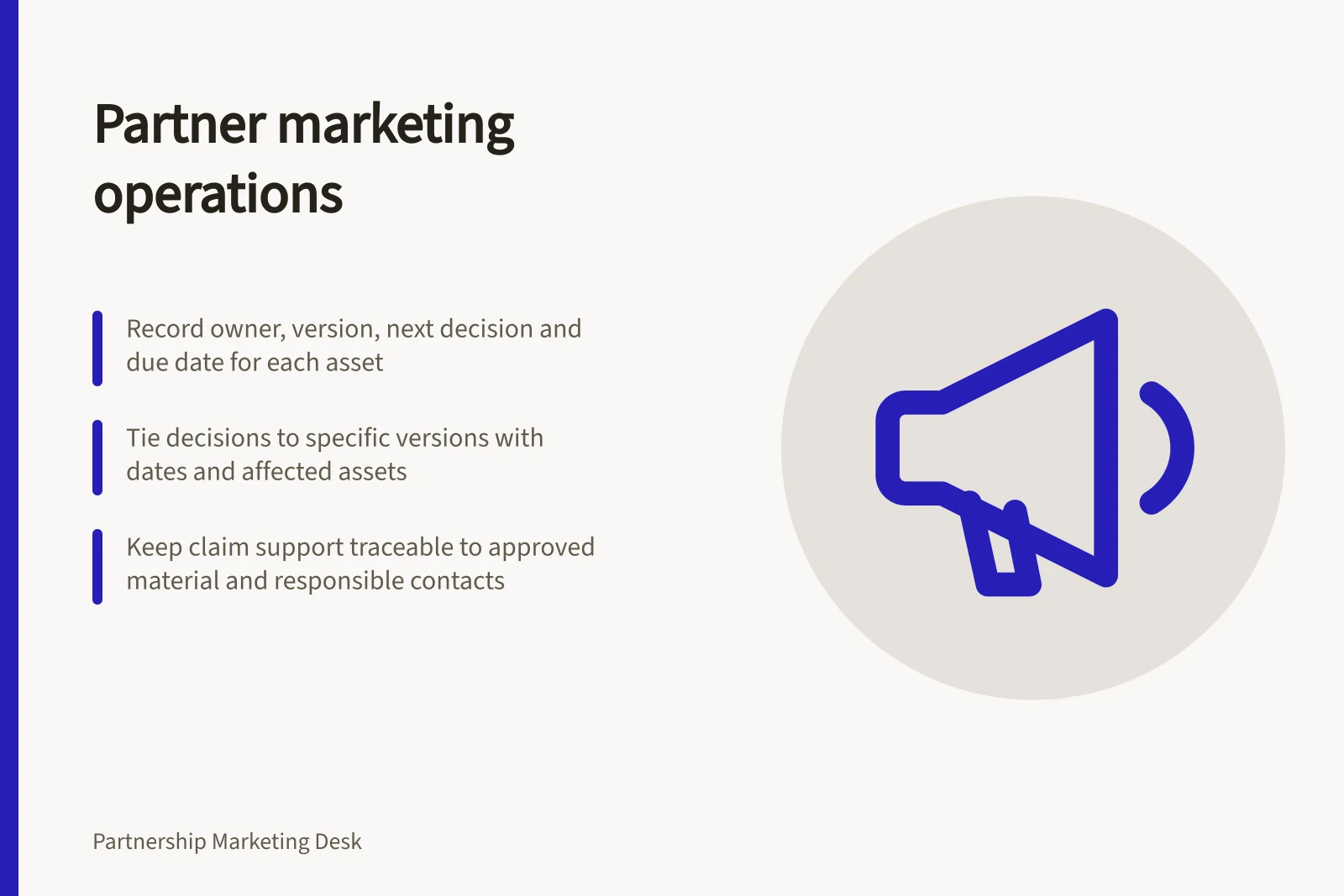
For each active asset, record its owner, current version, next decision, due point and intended channel. Use status labels both teams understand: proposed, in progress, waiting for input, in review, approved and released. A finished draft is not necessarily approved for publication.
Question / Record to check
- What happens next?
- Named owner, action and due point
- What is blocked?
- Missing input or decision and who can resolve it
- What may be released?
- Approval for the stated version and use
- What changed?
- Dated decision and affected assets or dates
Name someone to maintain the shared view. That coordinator does not automatically gain authority to approve either partner’s claims, brand use or spending.
Tie decisions to versions
For a material change, record the question, decision-maker, date, affected version and next action. Preserve a superseded decision so a replacement contact can follow the trail. An entry saying only “approved” is insufficient if the publishing owner cannot tell which copy, layout or channel it covers.
Before release, compare the scheduled material with the approved version. Have each partner verify claims about its own offer. Return a materially changed claim or layout to the affected reviewer.
Keep claim support traceable
For claims that need checking, link the relevant campaign version to the material supporting the claim and identify who can confirm it. The ACCC can require businesses to back up claims about their products or services, and may investigate possible misleading claims and take compliance or enforcement action.
If a concern about a live claim is raised, use the operating record to identify the affected copy, channel and release, then route it to the appropriate partner for a decision. The ACCC accepts reports about possible misleading or false claims; it does not resolve individual disputes or provide legal advice.
Applicable Australian regulations for joint campaign compliance
- ACCC – False or misleading claimshttps://www.accc.gov.au/business/advertising-and-promotions/false-or-misleading-claims
- OAIC – APP 6 (Use or disclosure of personal information)https://www.oaic.gov.au/privacy/australian-privacy-principles/australian-privacy-principles-guidelines/chapter-6-app-6-use-or-disclosure-of-personal-information
- OAIC – APP 11 (Security of personal information)https://www.oaic.gov.au/privacy/australian-privacy-principles/australian-privacy-principles-guidelines/chapter-11-app-11-security-of-personal-information
- ACMA – Spam preventionhttps://www.acma.gov.au/avoid-sending-spam
Respond to dependencies and delays
Review the record at handovers and release decisions. If an input slips, identify the work that depends on it, ask owners for revised dates and tell both partners which commitments have changed. Work that does not depend on the missing decision can continue.
An approval request should identify the reviewable version, the decision required and when a response is needed to preserve the proposed schedule. If that point passes, escalate the decision and revise the plan. Do not infer approval from silence unless the partners have expressly agreed a rule that applies to the item.
For a dependency that affects release, make the consequence visible in the operating record: which asset or activity is waiting, what decision or input is missing, and whether the proposed release can proceed without it.
Check access and distribution
Give campaign participants access suited to their roles and update it when roles change. If the workspace contains personal information, assess proposed access or sharing before opening it to another organisation.
Creative approval does not settle whether a campaign message may be sent to an audience. Check applicable requirements before distribution, including where another business sends on your behalf.
Log data-use dependencies
When a campaign involves personal information, record what information is being used, why it was collected and which organisation will use or disclose it. For an APP entity, APP 6 generally limits use or disclosure to the purpose for which the information was collected, unless an exception allows a secondary purpose.
Before a planned use or disclosure, check whether an exception applies. The OAIC lists examples including the individual’s consent, a secondary purpose the individual would reasonably expect that is related to the primary purpose, and use or disclosure required or authorised by Australian law or a court or tribunal order.
Where sensitive information is involved, the reasonable-expectation exception requires the secondary purpose to be directly related to the primary purpose. Record the basis relied on and who checked it, so a change in audience, recipient or campaign use can be sent back for review rather than treated as an administrative update.
Record what went out
After release, record what appeared, where, when and by whom. Keep an owner for correcting a live claim or pausing scheduled material if an offer changes. At close-out, identify unfinished work and live assets needing an owner. Use a separate retrospective to examine what the campaign taught the partners.
Compliance and operational metrics for joint campaigns
- Campaigns with traceable claim support
- Required by ACCC under advertising laws
- Personal information retention policy
- Must be destroyed or de-identified if no longer needed (APP 11)
- Spam compliance requirement
- Follow ACMA guidelines when distributing messages
Protect and retire shared records
For an APP entity that holds personal information, APP 11 requires reasonable steps in the circumstances to protect it from misuse, interference and loss, as well as unauthorised access, modification or disclosure. The OAIC says those steps include technical and organisational measures, so campaign access controls and handling practices both matter.
At close-out, check whether personal information in campaign workspaces is still needed for a purpose permitted under the APPs. If it is no longer needed, an APP entity must take reasonable steps to destroy or de-identify it, unless it is part of a Commonwealth record or must be retained under Australian law or a court or tribunal order.
Record the close-out action and any permitted retention, and remove access that is no longer needed for campaign work. APP 11 applies to personal information the entity holds, including records in its possession or control; the applicable obligations depend on the organisation and information involved.
In this guide
- Maintaining a record of shared campaign commitmentsKeep a dated record of what each campaign partner accepted, delivered or changed, with owners, due points and evidence of completion.
- Managing a partner's delayed approvalFind the decision blocking a joint campaign, give the approver a complete version and choose a revised release plan.
- Replacing a campaign contact without losing decisionsHand over current campaign decisions, versions, open commitments and approval authority when a partner contact changes.
- Preparing a joint campaign retrospectivePrepare a shared account of delivery, decisions and customer response, then leave a joint campaign review with owned improvements.