Joint Campaigns
Part of Joint campaign planning
Choosing a co-marketing offer both audiences need
Test a proposed co-marketing offer against both audiences’ needs, each partner’s contribution and the limits of its promise.
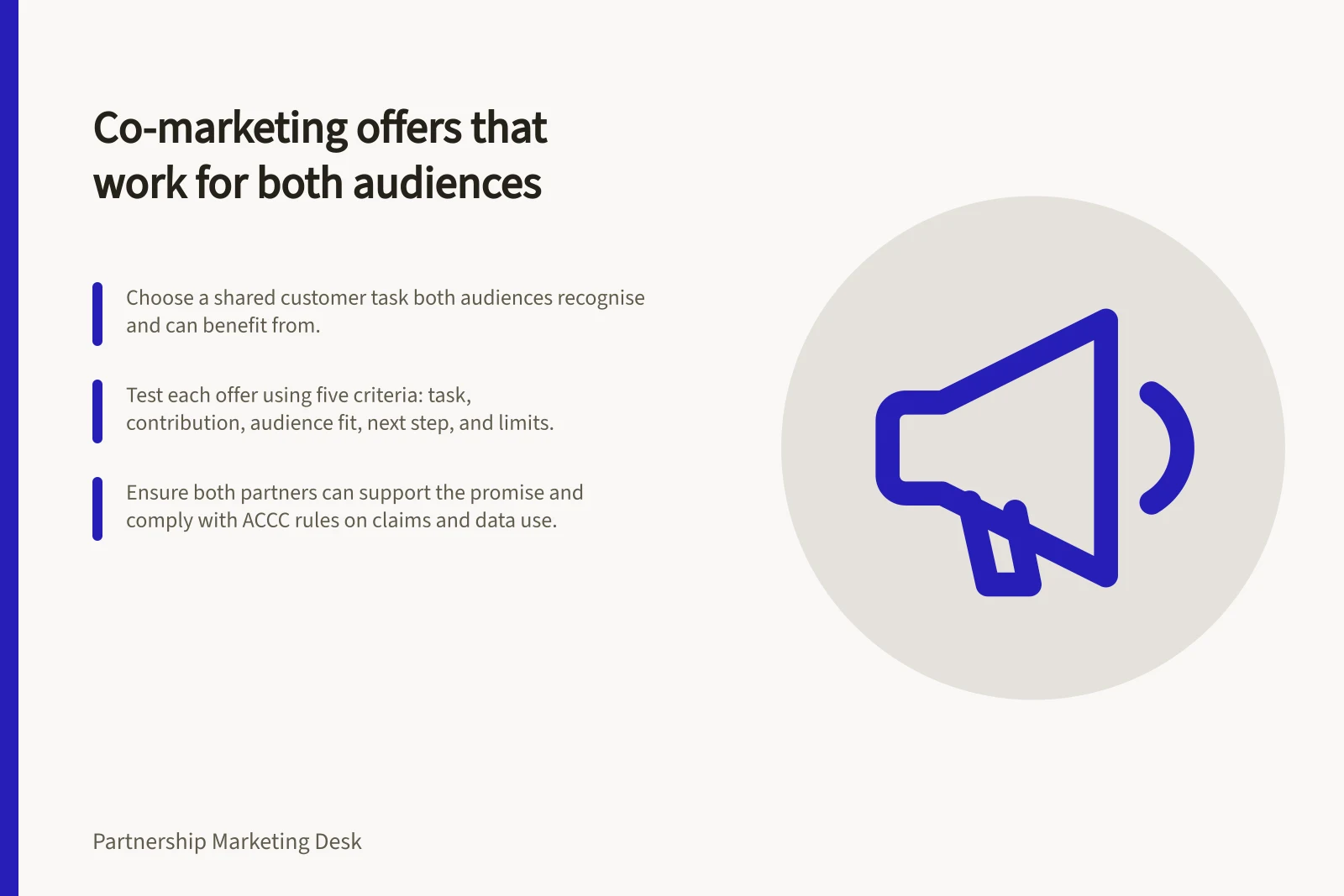
Choose a co-marketing offer around a customer task both audiences recognise, with a useful contribution from each partner. If it makes sense to only one audience, narrow the audience or change the offer before making campaign assets. Two logos on a generic download give customers no reason to use it.
Compare the need on both sides
Ask each partner what its customers are trying to do when the proposed topic arises. Capture the question in customers’ terms, their stage of need and the help the partner can provide. Look for a common task or a useful handoff between adjacent tasks.
For example, one business might help operations teams prepare data; another might help them use it in reports. A joint checklist about that handoff could be useful if both partners can verify their advice. Confirm that their intended audiences actually face that task before developing it.
A shared job title does not prove shared need. One partner’s finance managers may be learning a process; the other’s may be selecting a service. Write a short need statement for each audience, then compare the questions each would bring to the offer.
Test the offer before choosing its format
Run a few possible offers through the same questions:
| Test | What to establish |
|---|---|
| Customer task | The decision or action the material helps with |
| Contribution | What each partner adds that the other cannot supply alone |
| Audience fit | Suitable users and people the offer does not suit |
| Next step | Something useful a customer can do without an immediate sales call |
| Limits | Eligibility and conditions that can be explained plainly |
A short checklist may suit a readiness check; a worked example may suit a question about how two services fit together. Choose the smallest format that can answer the question credibly.
Ask what the reader would lose if either partner’s contribution vanished. If the answer is “only a logo”, revise the offer. This tests the proposed value; it does not predict campaign results.
Keep the promise within what both teams can support
State what the offer contains and excludes. A resource about preparing for a service should not imply that using it guarantees acceptance, savings or another result.
Have each owner check claims about its organisation’s offer. Put material conditions beside the benefit they qualify. Australian guidance says the ACCC can require businesses to back up claims about their products or services, and it can act on misleading behaviour.
If access requires a registration form or business details, decide what information is needed and who receives it. Before building that transfer into access to the offer, assess any proposed transfer of personal information against the rules that apply to the organisations and purpose.
Make a choice the campaign can use
Write a short offer statement naming the intended customer, task, what the customer receives, each partner’s contribution and the main limit. Ask someone familiar with each audience why its customers would use it. If the answers differ, revise the statement.
Then decide whether to develop the offer, narrow it to one audience, gather more evidence of need or stop. Choose channels and dates after the offer is clear.