Joint Campaigns
Part of Managing a partnership portfolio
Avoiding several partners competing for the same campaign
Define the available campaign role, compare partner proposals consistently and explain the allocation decision.
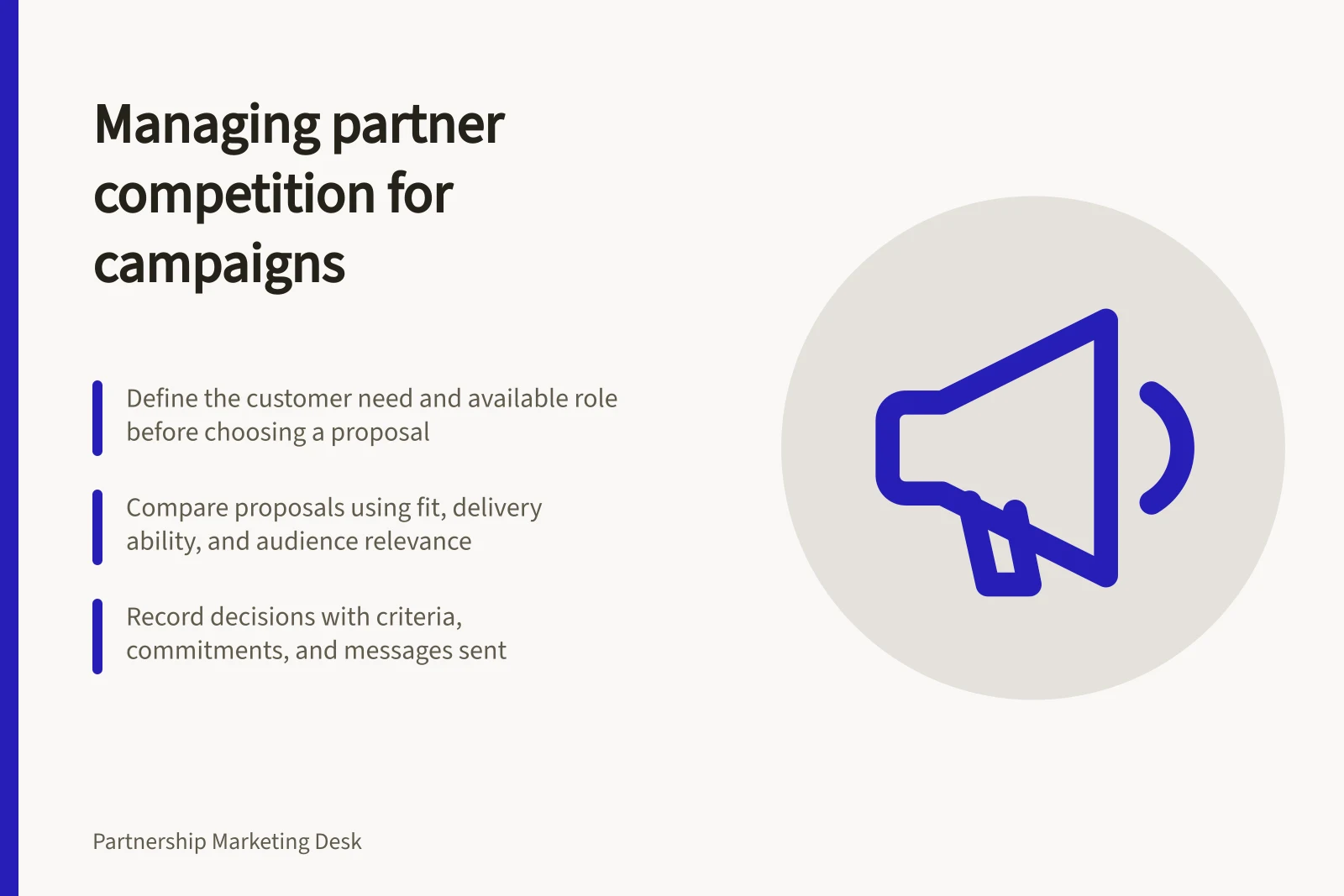
When several existing partners seek the same campaign, define the customer need and the available role before choosing a proposal. Compare each proposal against criteria set for that activity.
Identify the collision
“Both want a webinar” is too vague. Check whether the proposals seek the same audience, question, offer, channel, period and level of endorsement.
Two partners may bring distinct expertise to one session. Two similar offers may instead leave customers unsure which one the business recommends.
Describe the available role: subject expert, co-author, distribution partner, sponsor or recommended provider. Ask what the audience gains from each contribution. If both partners expect to be the sole recommended solution, the team needs an allocation decision.
Compare proposals consistently
Choose criteria tied to this campaign: fit with the customer question, evidence for the contribution, ability to deliver, relevance to the intended audience and existing commitments. Request comparable information from each partner. An unverified audience-size figure is not a substitute for fit.
- Combine rolesif distinct contributions make the activity clearer for customers.
- Choose oneif the campaign needs one provider or perspective, and record why that proposal fits.
- Separate activitiesif the partners address different questions or stages.
Rotation may help allocate repeated opportunities, but it should not override the needs of this campaign. If neither proposal is ready, defer the activity.
Check commitments and information boundaries
Ask agreement owners to check relevant category, channel, timing, brand and exclusivity terms before offering a slot. Do not infer exclusivity from a public partner logo; check the agreement. The ACCC investigates exclusive dealing arrangements that are potentially anti-competitive and does not intervene directly in disputes between businesses.
If competing businesses are involved, keep planning focused on the customer activity. Avoid sharing future prices, customer-allocation plans or other commercially sensitive strategy.
The ACCC takes reports about possible anti-competitive communication and cooperation among businesses, and investigates possible anti-competitive contracts, arrangements, understandings and concerted practices. Seek appropriate advice if the proposed activity depends on such exchange.
Key Compliance Considerations from ACCC Guidance
- Exclusive dealing
- ACCC investigates anti-competitive arrangements; does not intervene in private disputes
- Cooperation among businesses
- Must avoid anti-competitive understandings or concerted practices
- False or misleading claims
- Campaigns must not misrepresent offers or endorsements; enforceable under Australian Consumer Law
Explain and record the decision
Tell each partner the role offered, the activity it covers and what remains undecided. Give a declined partner a reason based on campaign fit without disclosing another partner’s confidential proposal. Do not imply a continuing endorsement when the decision covers one campaign.
For example, a guide on preparing business data might use a specialist who can verify preparation steps, while a later guide about interpreting reports uses a different expert. That illustrates separate customer questions; it says nothing about either partner’s performance.
Keep a brief record of the criteria, evidence, commitment check, authorised decision-maker, role offered to each partner and messages sent. Revisit the allocation if the audience, offer or capabilities change. Before release, have each participant verify claims about its own offer and the role the campaign presents.