Joint Campaigns
Part of Co-marketing budget management
Deciding whether a partner campaign deserves more funding
Decide whether to repeat, revise, test or expand a partner campaign using delivery, relevant outcomes, full costs and a bounded next proposal.
Fund a defined next campaign activity when its likely customer value, full cost and remaining uncertainty justify that commitment for both partners. An encouraging first report may support a limited repeat or test, but not a larger programme. Before approving extra money or work, state what they will change.
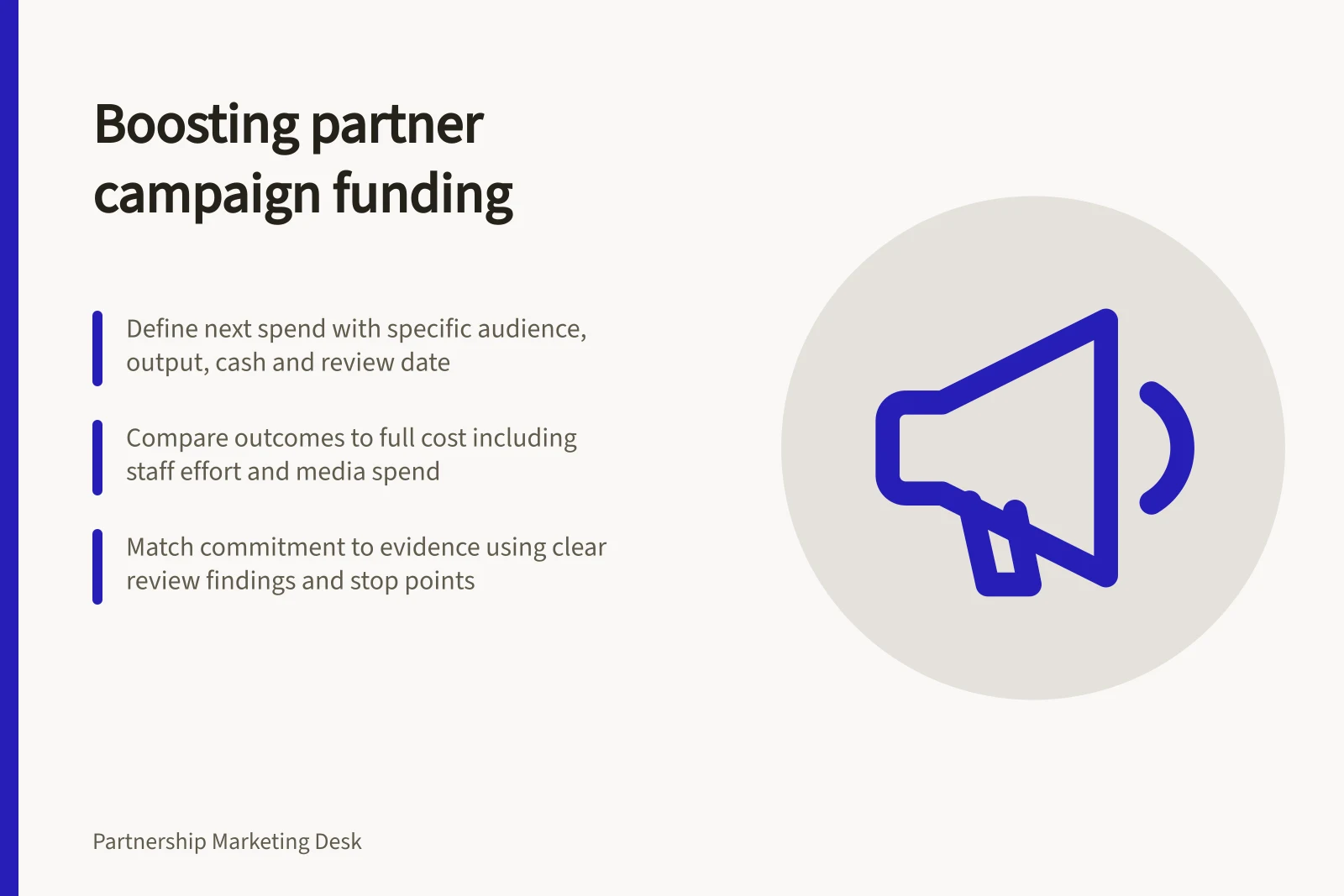
Define the next spend
Replace “invest more in the partnership” with a specific proposal: repeat an offer for another suitable audience, improve a weak distribution step, revise an asset or add paid promotion. Name the customer group, output, additional cash, partner work, payment timing and review date.
Check whether the first activity was delivered as planned. A missing distribution step limits what its result says about demand. A well-delivered campaign that attracted mostly unrelated questions raises a different concern.
Record what the evidence supports and what remains uncertain. This is a campaign funding decision, not a verdict on the whole partnership.
Compare outcomes with full cost
Use the goal and outcome definitions agreed before launch. Keep reach, participation, qualified enquiries, opportunities and sales separate. State the eligible audience and observation period behind each count. If later commercial outcomes are still open, report them as open.
Put outside invoices, media spend and meaningful staff effort from both partners beside the outcomes. Then estimate the additional cost of the proposed next step. A new audience, revised asset or extra follow-up may require work beyond repeating the original activity.
Recorded campaign involvement does not prove added demand. If a larger commitment depends on that claim, plan a credible comparison for the next activity using the same outcome definition and observation period. If a sound comparison is impractical, use the available evidence directionally and keep other plausible causes in view.
Key metrics to track in partner campaign evaluation
- Reach
- Number of people exposed to the campaign
- Participation
- Engagement rate (e.g., clicks, sign-ups)
- Qualified enquiries
- Inquiries meeting predefined criteria
- Opportunities
- Potential sales leads identified
- Sales
- Completed transactions attributed to the campaign
Match the commitment to the evidence
| Review finding | Funding response to consider |
|---|---|
| Relevant response, sound delivery and affordable next step | Fund a defined repeat or expansion with a review point. |
| Relevant questions but an identifiable delivery gap | Fund the specific fix before increasing scale. |
| Encouraging early activity but uncertain enquiry quality | Run a limited follow-up and wait for the agreed outcome window. |
| Weak customer fit despite sound delivery | Revise the offer or audience before buying more reach. |
| Costs or payment timing exceed a partner's capacity | Reduce scope or defer. |
These are prompts, not universal thresholds. Each partner must decide what uncertainty it can accept at the proposed spending level.
Approve a bounded proposal
Record the next deliverable, each partner's cash and in-kind contribution, approval limit, payment timing, success signal and stop or review point. Ask the authorised decision-makers to approve that proposal. At the review date, compare actual spending and delivery with it, then decide whether to continue, narrow or stop.