Joint Campaigns
Part of Co-marketing agreements and responsibilities
Dividing production costs between partners
Agree which production costs are shared, who pays suppliers, how contributions count and who approves overruns.
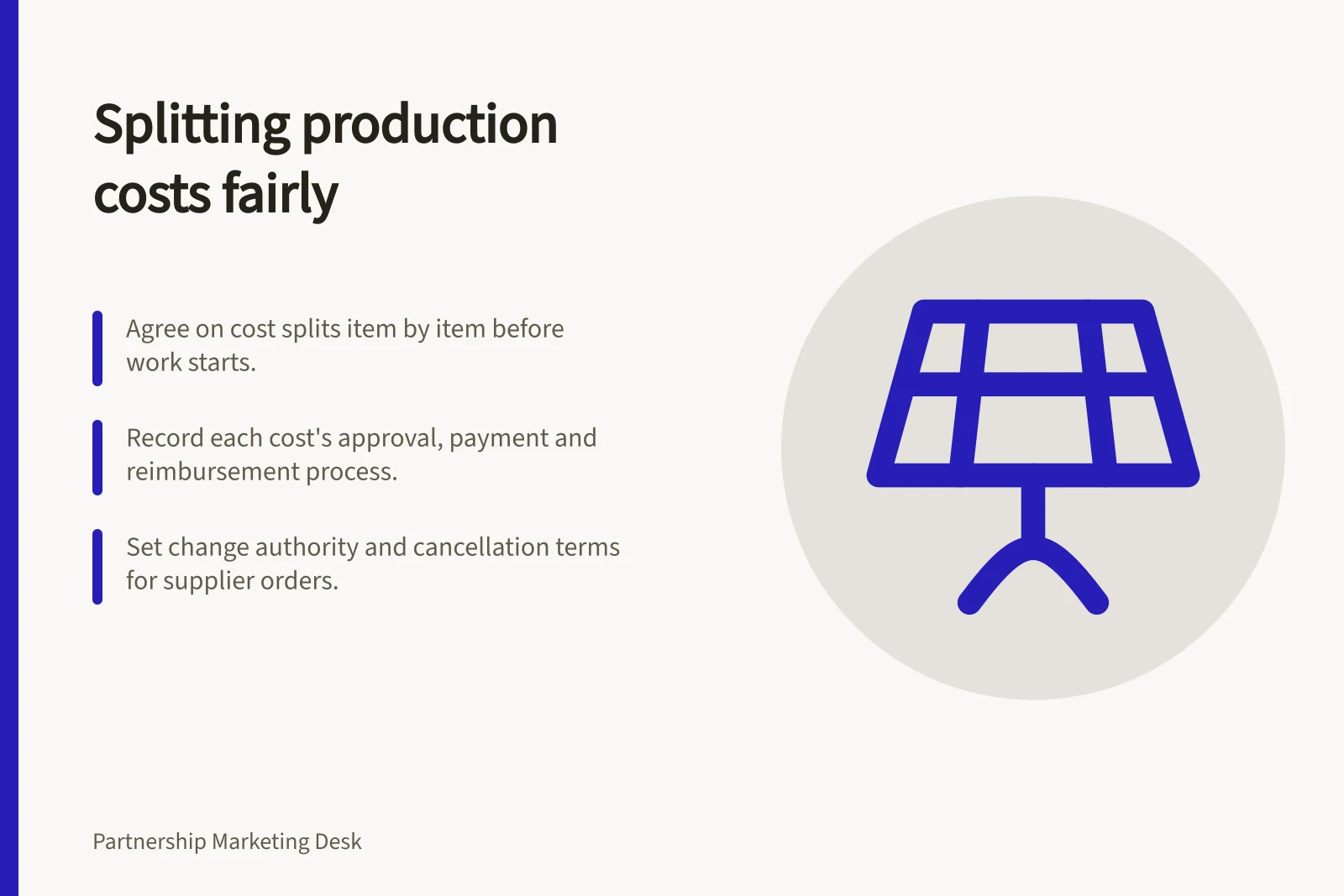
Divide production costs item by item before either partner commissions work. For each expense, agree what will be bought, who can approve it, who pays the supplier and how the partners will settle their shares. “Split the costs” is too vague when one partner provides staff time and the other receives an agency invoice.
Define the costs being shared
List the campaign outputs, then the resources needed to produce them. A guide may need writing, design, accessibility work and an external illustration; an event may need editing and captioning. Distinguish third-party charges from work performed by either partner’s staff. If staff time counts towards the arrangement, agree its value and how it will be recorded before work starts.
Say whether media spend, routine salaries and later distribution are included. Mark costs one partner may commit alone, costs requiring both approvals and items outside the arrangement. A supplier quote should identify its deliverable and included revisions; a quoted price does not authorise optional additions.
Record an allocation for each item
| Field | Question to settle |
|---|---|
| Cost item | Which defined output or service is being bought? |
| Approved amount | What is the cap and are quoted amounts being treated consistently? |
| Contracting party | Who places the order and receives the invoice? |
| Allocation | What share does each partner bear, and does staff work count? |
| Payment | Who pays first, what evidence is needed and when is any reimbursement due? |
| Change authority | Who may approve more work or a higher price? |
The partners may agree equal cash shares, separate responsibility for different items or another allocation suited to expected use. These are choices to make for this campaign, not default rules.
Record asset ownership and reuse separately: paying a supplier does not, by itself, settle who may use the resulting design. IP Australia advises collaborators to agree ownership and use of newly created material.
Cost allocation options for joint campaigns
- Separate responsibilityOne partner handles specific items (e.g., design), the other handles others (e.g., editing).
- Proportional based on useAllocation reflects expected usage or benefit (e.g., one partner uses output more heavily).
Check the cash flow
Suppose, solely as an arithmetic example, Partner A pays an approved $4,000 design charge and Partner B pays an approved $2,000 editing charge. If the partners share those two charges equally, each bears $3,000.
Partner B would reimburse Partner A $1,000 under their agreed invoicing and evidence process. This assumes those are the only included amounts and makes no statement about GST, staff time or later changes.
Record approved commitments, invoices received, payments made and reimbursements due as separate entries. This shows the difference between an agreed allocation and cash already spent.
Control changes and cancellations
Set a cap for each supplier order and name who can change it. Decide whether an overrun waits for written approval, falls to the party requesting it or is shared under a new allocation. A project contact should not be assumed to have spending authority.
Check the supplier’s cancellation terms before ordering. Agree who bears an applicable charge and who receives any completed work. If one partner requests an extra version for its own channel, settle whether it is a shared expense before commissioning it.
At handover, compare actual invoices with the approved cost list and identify any difference for settlement. That closes this campaign’s production commitments; it does not measure the wider partnership’s return.