Lead Sharing
Part of Co-marketing budget management
Reconciling expenses after a joint campaign
Match approvals, invoices, payments and partner shares after a joint campaign, then resolve credits, missing charges and reimbursements.
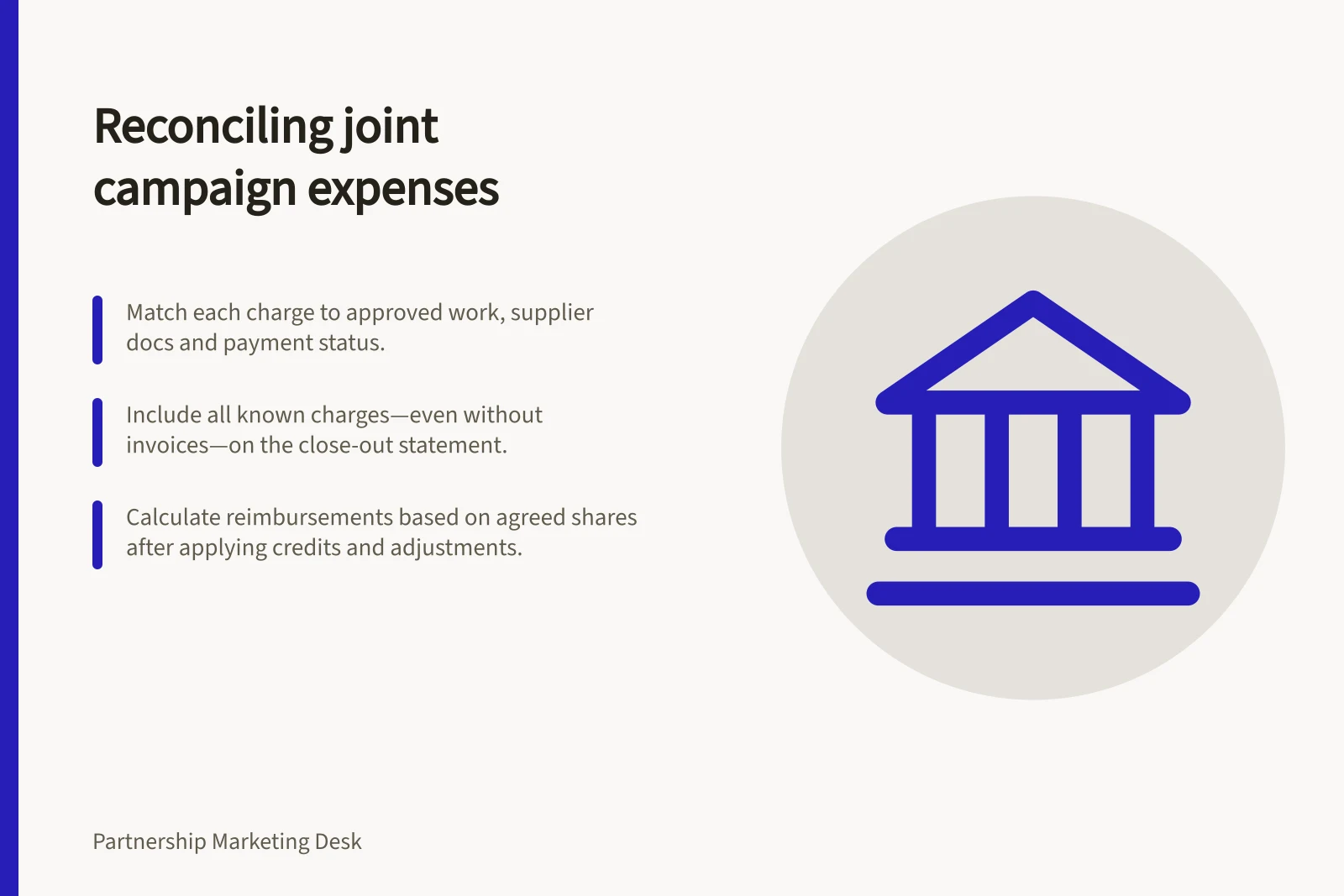
Reconcile a joint campaign by matching each charge with the approved work, supplier document, payment status and agreed partner share. Identify credits, missing invoices and disputed items before calculating reimbursements. A finished campaign may still have unsettled costs.
Set the close-out scope
Choose a cut-off date for the first statement and a contact at each partner who can resolve questions. Gather the original allocation, approved changes, orders, invoices, credit notes, payment evidence and any agreed in-kind records. List known charges whose invoices have not arrived separately; do not treat them as zero.
Give each distinct supplier charge one line and retain its invoice reference. An invoice may cover several campaign items, and copies may appear in both partners' records. Count the charge once. A reimbursement between partners settles their allocation and is not another production expense.
Match authority, amount and payment
For each line, confirm the delivered service, approval, invoice amount, payer and allocation rule. Mark a difference as an approved change, possible error, pending evidence or dispute. Use a consistent GST basis for the shared comparison, while each business checks its own invoice and tax treatment.
Status / Close-out treatment
- Approved and paid
- Include once in the agreed cost and payer totals.
- Approved and invoiced, but unpaid
- Show the obligation and who will pay it.
- Work ordered, invoice pending
- Show a separate estimate until the amount is confirmed.
- Credit or cancellation
- Link it to the original charge and adjust that line.
- Unapproved or disputed
- Keep it outside the agreed settlement pending a decision.
An invoice requests payment; payment evidence shows what was paid. Neither alone establishes approval for an extra charge. Retain the decision behind any changed amount.
Calculate the settlement
Suppose Partner A has paid an approved $2,400 supplier charge and Partner B an approved $600 charge. If these are the only included costs and the partners share them equally, the total is $3,000 and each share is $1,500. B has paid $900 less than its share, so B reimburses A $900 under their agreed process.
Now suppose A receives a $400 credit against its charge before settlement. A's net supplier cost becomes $2,000, the combined cost $2,600 and each share $1,300. B would reimburse A $700.
If the credit arrives after the $900 reimbursement, record a further $200 adjustment from A to B. These are hypothetical management figures; actual invoices, payment status and GST treatment must be checked separately.
Agree the remaining differences
Give both partners the same dated statement: agreed cost, paid amount by partner, open supplier balances, reimbursement due and unresolved lines. Ask each to confirm the calculation or identify a missing document. Preserve the earlier statement and dated correction if a late invoice changes the result.
The close-out establishes the campaign cost and who owes whom under the agreed rule. Whether another campaign deserves funding requires separate evidence of customer response.