Partner Enablement
Channel partner marketing support
Plan channel partner marketing support around accurate product claims, adaptable campaigns, partner training, content review and useful asset measures.
Channel partner marketing support helps resellers explain and promote a supplier’s offer accurately to their own customers. It combines a reliable product brief, adaptable campaign materials, training, review of customer-facing content and feedback on what partners use.
Start with the questions a reseller must answer for a buyer, then choose the support that helps it answer them.
Match support to the partner’s role
Ask how each partner sells, which customer problems it handles and who can run a campaign. A reseller with a marketing team may need editable files, while a smaller partner may be better served by a finished email and a short product explanation. A referral partner needs different material from a reseller that installs and supports the product.
| Partner need | Useful support | Agree before launch |
|---|---|---|
| Explain the offer | Product brief and approved claims | Features, conditions and limits |
| Reach customers | Adaptable copy and layouts | Audience, offer and call to action |
| Answer objections | Demonstration and escalation contact | What the partner can confirm itself |
| Publish under both brands | Brand assets and review route | Usage rights and sign-off responsibilities |
| Improve the material | Usage records and partner feedback | What each signal can show |
Keep product claims current
Maintain a dated reference for each promoted offer: who it is for, what it does, prerequisites, exclusions, where to confirm current pricing and who can resolve an uncertain claim. Label an example as an illustrative use case or a measured result as appropriate. An example should not become a performance promise.
Give partners a simple way to report when approved wording no longer matches the product.
The ACCC accepts reports about possible misleading claims and uses them to inform its education, compliance and enforcement work. It can require businesses to back up claims about their products or services, investigate possible misleading conduct and take compliance or enforcement action. It does not resolve individual disputes or provide legal advice.
Let partners adapt campaigns within agreed limits
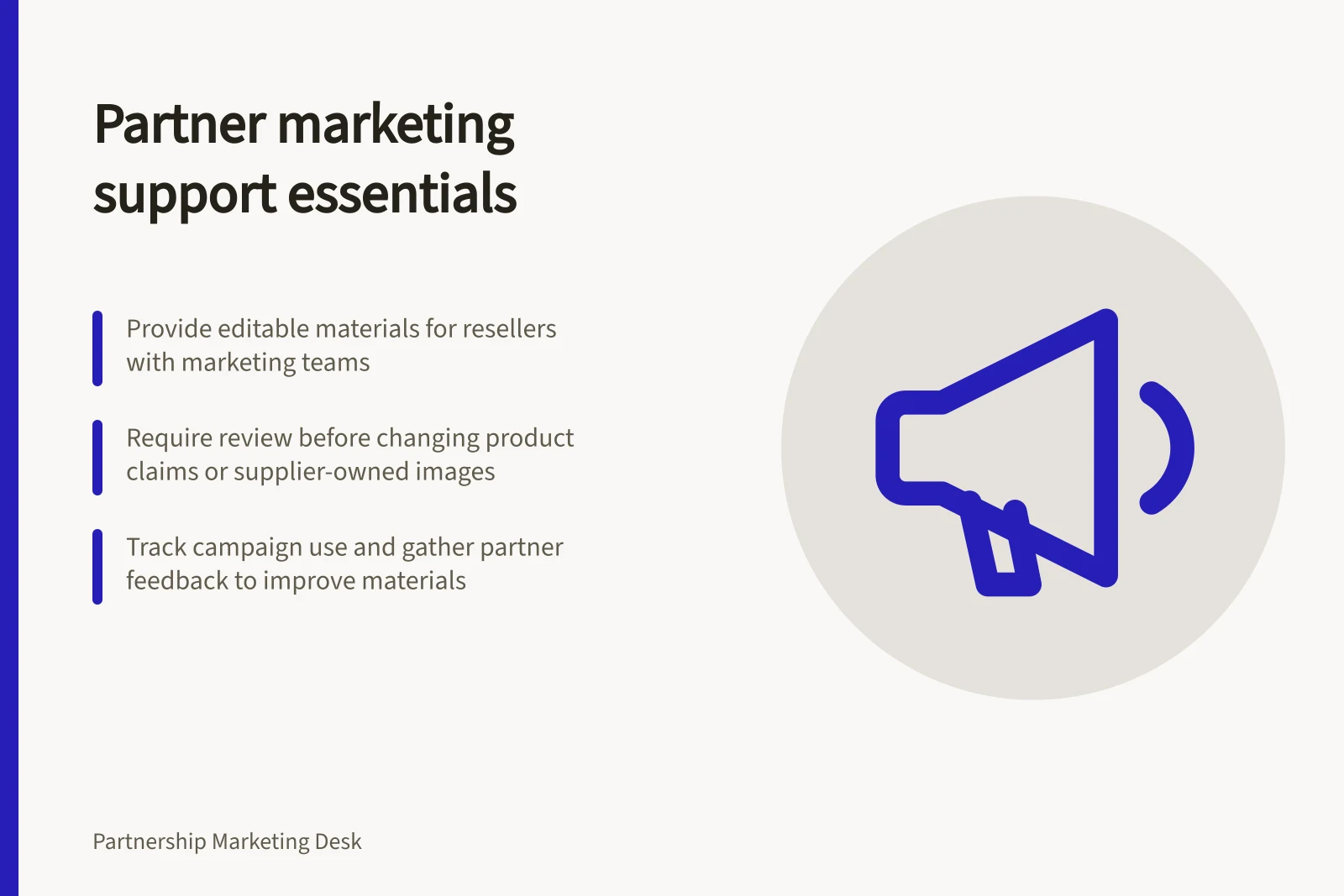
Build a compact kit around a defined customer problem. It might contain a brief, approved copy, an editable layout and a landing-page outline. Show which fields the partner can change, such as its contact details and service description.
Require review when it changes a product claim, an offer condition or a supplier-owned image. Confirm the rights to use logos and other assets in the intended channels.
Train and review before distribution
A partner contact should be able to explain the offer in their own words, state its important limits and know when to ask for help. Practise questions about eligibility, setup and the partner’s own services. Refresh the answers when the offer changes.
Review the finished page, email or presentation, including its headline, images, qualifications and call to action. Record approval against that version and channel. Check ACMA’s spam guidance when preparing marketing emails or texts.
Learn what partners actually use
Track whether eligible partners can find current material, adapt it and publish it. A view or download shows an interaction with a file; it does not show that a campaign ran or influenced a sale. Where practical, ask for a live campaign URL or sample and pair it with partner feedback. Investigate material that is rarely used, often rewritten or repeatedly returned for correction.
For a first cycle, choose one offer and a manageable group of partners. Give them the same verified product reference, allow relevant local edits, review the final message and record what reaches customers.
In INFUSE’s survey, 67% of vendors said fewer than half of their partners were actively marketing, while 10% said they did not know what their partners were doing. Nearly 80% said partner content and assets were poor and needed optimisation, and more than 80% said partners did not use campaigns shared with them.
Partner Marketing Performance Insights
- 67%Vendors reporting <50% of partners actively marketing
- 10%Vendors unsure what partners are doing
In this guide
- Giving resellers adaptable campaign materialsBuild reseller campaign kits with editable local fields, controlled product claims, clear rights and an update process partners can follow.
- Training partners to describe a product accuratelyTeach resellers to explain verified capabilities, state product limits, answer buyer questions and escalate claims they cannot confirm.
- Measuring use of a partner marketing asset libraryMeasure partner asset discovery, uptake and publication with clear denominators, version records and limits on what download data can prove.