Portfolio Review
Part of Managing a partnership portfolio
Grouping partnerships by the customer problem they solve
Group existing partners around customer tasks, check each contribution and identify overlap before planning joint activity.
Group existing partners by the customer task they help with, then state each partner's distinct role. Use the groups to help a team choose a useful activity, not merely to sort names by industry, tier or contract type.
Write the problem first
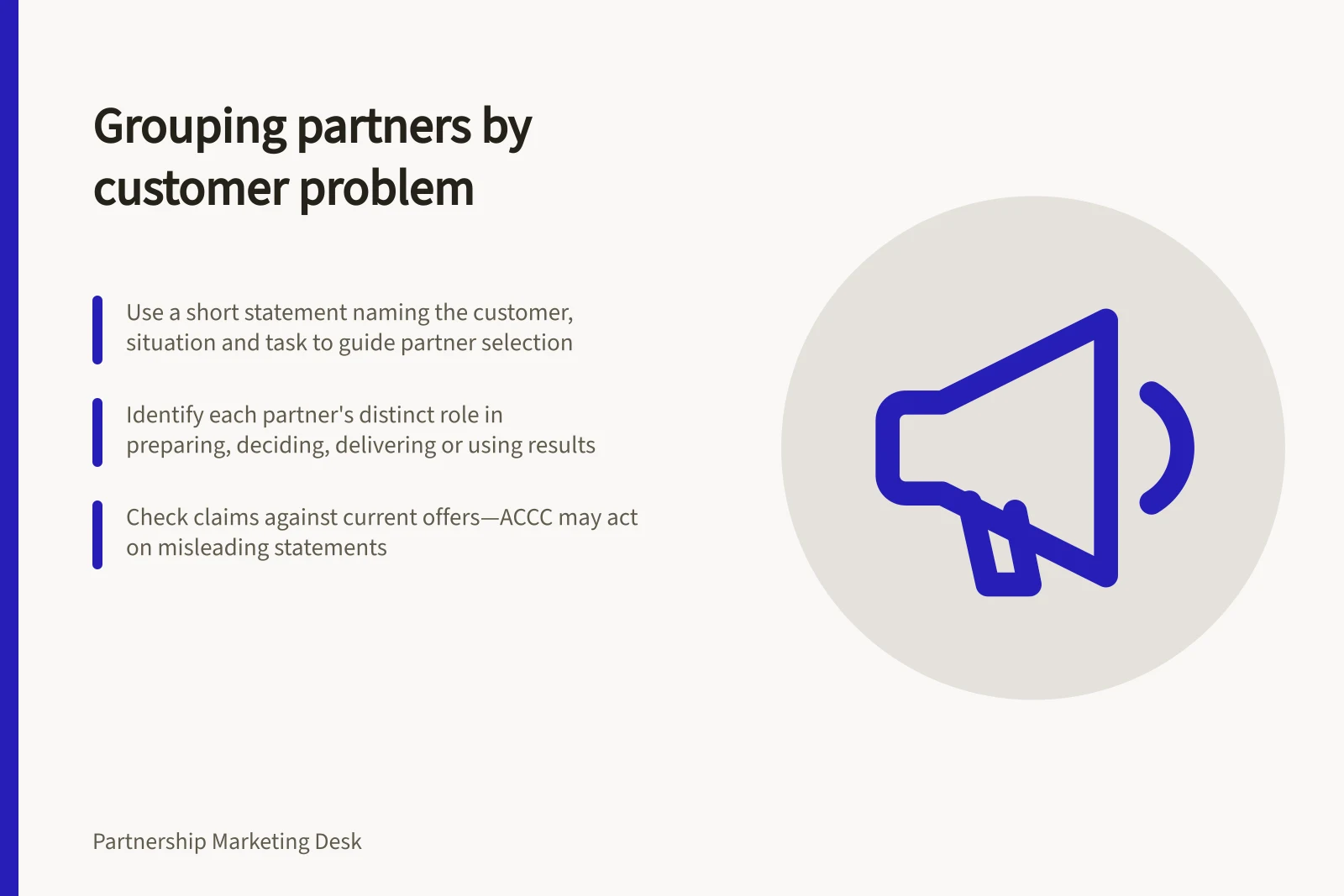
Use a short statement naming the customer, situation and task. For example: “A finance team preparing a reporting process needs to decide what information must be ready before implementation.” This is an illustrative problem, not evidence about a market. A label such as “digital transformation” is too broad to guide a partner decision.
Start with customer questions and hand-offs your team can document. Note who encounters the problem, when it appears and what would help them progress. Leave a group provisional if the underlying customer need has not been confirmed.
Describe each contribution
A partner might help customers diagnose the issue, prepare for a decision, complete a related task or use the result. Check the description against the partner's current offer. Two partners in one group may complement each other; different labels can also hide near-identical offers.
Field / What to record
- Customer problem
- The task or decision in the customer’s terms
- Suitable customer
- Role, situation and relevant limits
- Partner contribution
- What this partner can credibly add
- Place in the task
- Preparation, decision, delivery or later use
- Evidence to confirm
- Customer question or current offer detail
- Next use
- Joint activity, specialist input or no current action
This is a working classification, not proof that a campaign will succeed. A partner can appear in two groups when its contribution to each differs.
Test the boundaries
For two similar groups, ask whether customers would bring the same question to both. Combine them if they describe the same task, or clarify the different stage. For two partners in one group, ask what a customer gains from each. If their proposed contributions are interchangeable, flag the overlap before offering both the same campaign role.
“Prepare source data” and “choose a reporting method” could be separate steps in an illustrative workflow. One guide might connect them, but a claim that two products work together would need confirmation of their actual behaviour and requirements.
Key Considerations When Grouping Partnerships
- Avoid broad labelsDo not use terms like 'digital transformation'—they lack actionable detail.
- Check for overlapIf two partners offer identical contributions, flag the redundancy before joint campaigns.
- Australian complianceACCC requires businesses to substantiate claims made about products or services.
- Document gapsAn empty group indicates a missing capability—not an automatic need to recruit a new partner.
Make the grouping useful
Choose a small activity for a documented customer need where a partner adds a credible contribution. In a crowded group, clarify roles or compare proposals for the available activity. An empty group records a gap; it does not automatically justify recruiting another partner.
Check any public description against current offer details. Australian guidance notes that the ACCC can require businesses to back up claims they make about their products or services, and may act on misleading or false claims. The grouping is ready when another team member can explain why each partner belongs and what remains unconfirmed.