
Partner Evaluation
Strategic partnership marketing for B2B businesses
Build a B2B marketing partnership around a customer problem, complementary contributions, shared value and a small first activity.
Strategic partnership marketing starts with a customer problem two businesses can address better together. Define the customer, each partner’s contribution and the result both want before choosing a campaign. A shared logo or a larger combined mailing list is not, by itself, a reason to partner.
Decide what the partnership is meant to change
Name the buying situation first. A prospective customer might need specialist advice alongside a service, or need two parts of a workflow to work together. Ask what the customer can understand, evaluate or accomplish with both partners involved that would be harder with either one alone.
Turn that answer into a short proposition: “For [customer group] facing [problem], we will combine [contribution A] and [contribution B] so they can [useful outcome].” Treat it as a proposal to test, not a performance claim. If vague language is needed to sound valuable, the customer benefit may still be unclear.
Set each business’s aim beside the customer outcome. One partner may want to reach a new buying role; the other may want to help existing customers understand an adjacent service. Those aims can coexist if both partners are willing to serve the shared customer need.
Test market assumptions before committing
Market research can help check whether the customer problem is common enough to justify a joint activity. Examine customer needs, competitor strengths and weaknesses, and demand for the product or service. Not everyone will buy, so be specific about who is likely to need the offer.
Check how the target customers would use the product or service and how much they would pay. This can expose a gap between a useful-sounding partnership idea and an offer customers are prepared to consider.
Clarify each business’s market position as well as its partnership role. Positioning is how a business wants customers to think about its products or services; it should make clear what the business does, who it serves and why it differs from competitors. A joint proposition is stronger when it complements those positions rather than blurring them.
Choose the right kind of relationship
A co-created guide or educational event asks both teams to contribute expertise and distribution. A referral arrangement may suit a partner that can identify a relevant need but has little reason to build a joint campaign. An integration story only makes sense when the connected workflow is real and its requirements can be explained accurately.
Ask who develops the offer, who makes claims about it, who reaches the audience and what each organisation expects in return. A commission for an eligible referral and a jointly produced campaign serve different purposes. They can coexist if the work and terms are clear.
Check the commitment behind the relationship
A relationship can sound simple while requiring sustained work from both teams. HubSpot describes its co-marketing projects as full campaigns, with shared content creation and promotion responsibilities, and applies its content and campaign guidelines. Treat the label “co-marketing” as a prompt to confirm the actual commitment, not as a fixed level of effort.
Check whether audiences and capabilities fit
A useful partner serves people involved in the same customer problem while adding something your business cannot credibly offer alone. Compare the roles, organisation types, needs and buying stages each business can reach. Similar audience labels can hide different needs: “operations leaders” might mean first-time buyers for one business and established customers for another.
Look for a contribution the other team can demonstrate, such as subject expertise, a relevant service, a suitable customer channel or a working product connection. Ask what its audience would gain from your contribution too. If only one partner can explain the benefit, narrow the proposition before committing resources.
An early fit discussion can use customer profiles, public material and broad audience descriptions. It does not require exchanging contact lists. Plan any later use or sharing of personal information separately, according to the information, purpose and rules that apply.
Agree on value before planning a campaign
Write down the customer benefit, each partner’s business aim and what each will contribute. Include limits that affect the promise, such as a particular customer type, setup step or service boundary.
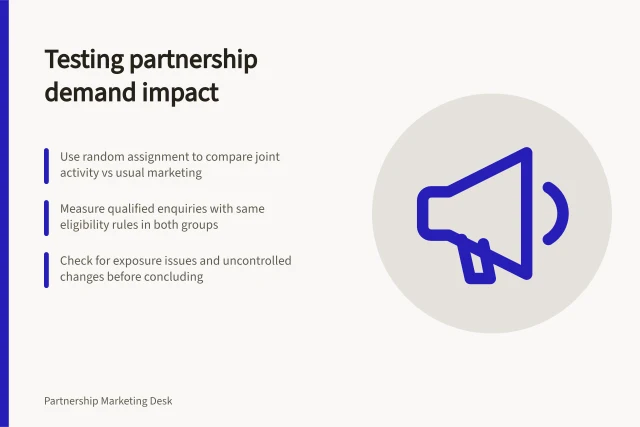
Choose a useful first signal. For an educational activity, that might be qualified questions about the shared problem. For an integration, it might be enquiries from customers eligible to use the connected workflow. Agree on definitions before launch: registrations, enquiries and sales are different events.
Put the activity alongside a basic marketing plan: identify the target market, the goal, the channels and activities, and a basic budget. business.gov.au’s marketing plan guidance also recommends setting goals and time frames, then evaluating whether the activity succeeded.
Keep the first commitment proportionate to what the partners have learned. If market research or the fit discussion leaves demand, audience or positioning uncertain, use that uncertainty to narrow the test rather than treating an ambitious reach target as proof of customer value.
Run a small first activity
Choose an activity that can test the proposition without assuming a large program will work. Confirm:
- the audience and customer question the activity addresses;
- each partner’s contribution and approval responsibility;
- what each may say about the other’s offer;
- where the activity will appear and who handles customer questions;
- the signals and date for deciding what comes next.
The ACCC can require businesses to back up claims they make about their products or services. If either partner plans to send marketing emails or messages, consult the ACMA’s guidance on avoiding spam before distribution.
After the activity, compare customer questions with the problem you intended to address. Keep, narrow or stop the proposition on that evidence.
In this guide
- Strategic co-marketing versus affiliate commissionsCompare joint campaign work with commission-based referrals and choose the arrangement that fits each partner’s contribution.
- Choosing a partner with a complementary customer baseAssess whether two B2B customer bases share a relevant problem and whether each partner brings a distinct contribution.
- Defining shared value before planning a campaignAgree the customer benefit, each partner’s return, distinct contributions and limits before choosing a joint campaign format.