Partner Evaluation
Part of Finding and evaluating co-marketing partners
Building a partner shortlist from customer workflows
Map customer tasks and hand-offs to find co-marketing candidates, record the evidence for each and decide who merits an approach.
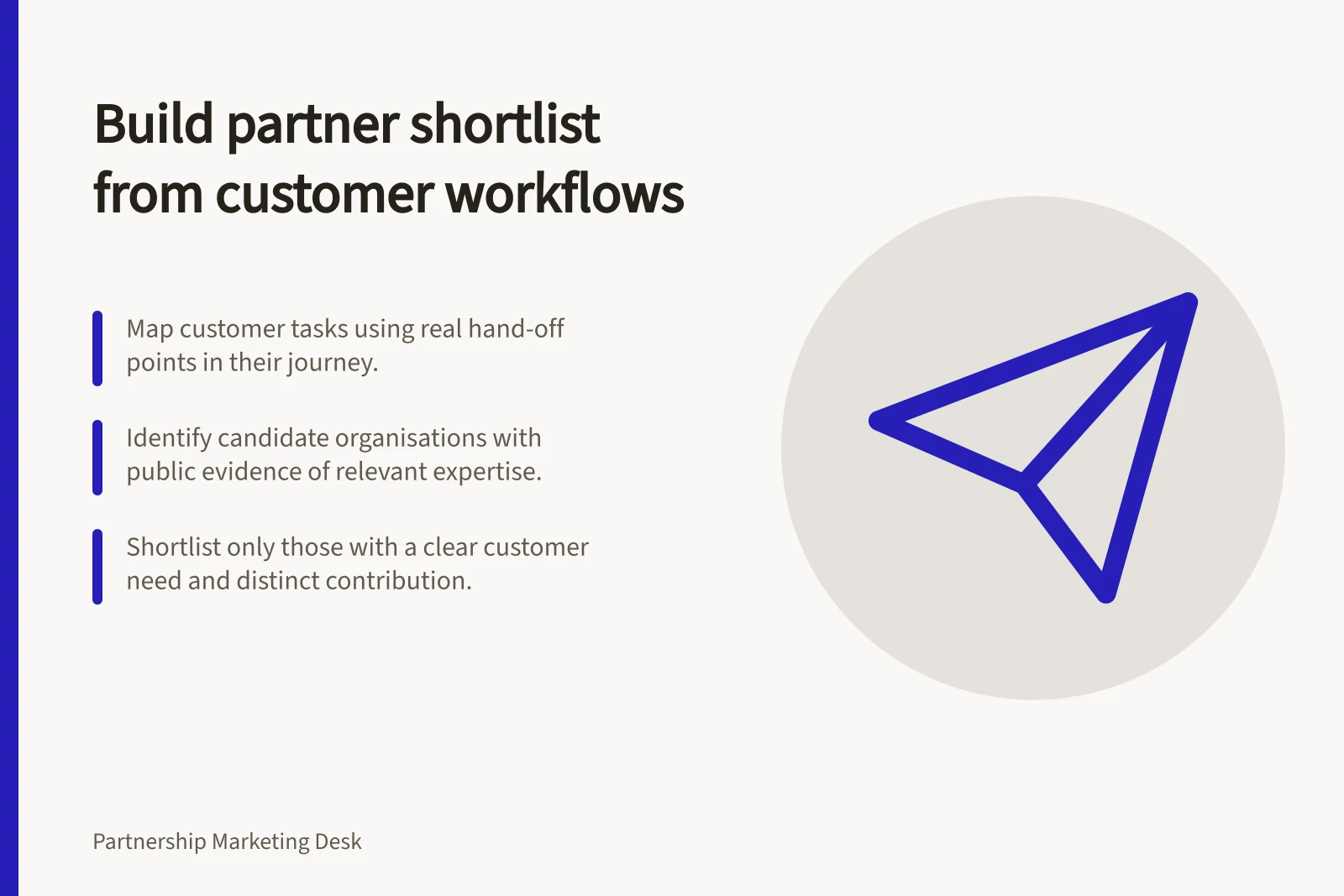
Build a co-marketing partner shortlist from the steps customers take before, during and after the task your business supports. Look for organisations that could help at a real hand-off point. Each name needs a customer-based reason for investigation, not just a recognisable brand.
Map one customer task
Choose one customer group and describe a task in its own terms: what prompts it, what information is needed, what happens next and where progress stalls. Use questions raised with sales, service or account teams where you have appropriate access. Distinguish recurring questions from a single anecdote.
Suppose customers ask how to organise source data before producing a management report. Training, data preparation or reporting expertise might help at different points. These are possible candidate types, not evidence that any organisation serves those customers or would make a suitable partner.
Turn hand-offs into candidate types
For each hand-off, write down the customer need and the contribution that would help. Look for organisations with public work relevant to that contribution. Keep a compact research record:
Field / What to record
- Workflow point
- The customer task or decision
- Evidence of need
- Recurring question or documented hand-off
- Candidate contribution
- Expertise, service or resource that could help
- Candidate name
- Organisation to investigate
- Public evidence
- Relevant offer, guide, event or published work
- Open question
- What that material cannot establish
A directory listing or shared customer label is a lead. The organisation may serve a different customer size, location or stage.
Narrow the list
Check whether each candidate’s published material addresses the task and adds something distinct from your business. Note a plausible channel for reaching the intended audience, but do not infer its reach or capacity from the existence of a guide or event page.
Record disqualifying observations alongside promising ones. If an offer overlaps yours, describe where. If the evidence is thin, leave an open question rather than treating an assumption as a fact.
Choose the candidates you could approach with a clear customer question and a specific reason their contribution might help. A useful opening might be: “Customers doing [task] reach [hand-off]. Your work on [adjacent need] suggests a joint resource may help. Is that a need you also see?”
The shortlist is ready when each name has a workflow reason, observable support for its proposed contribution and an honest question to resolve. Audience overlap and conflicts need their own assessment before any candidate becomes a partner.