Partner Evaluation
Part of Finding and evaluating co-marketing partners
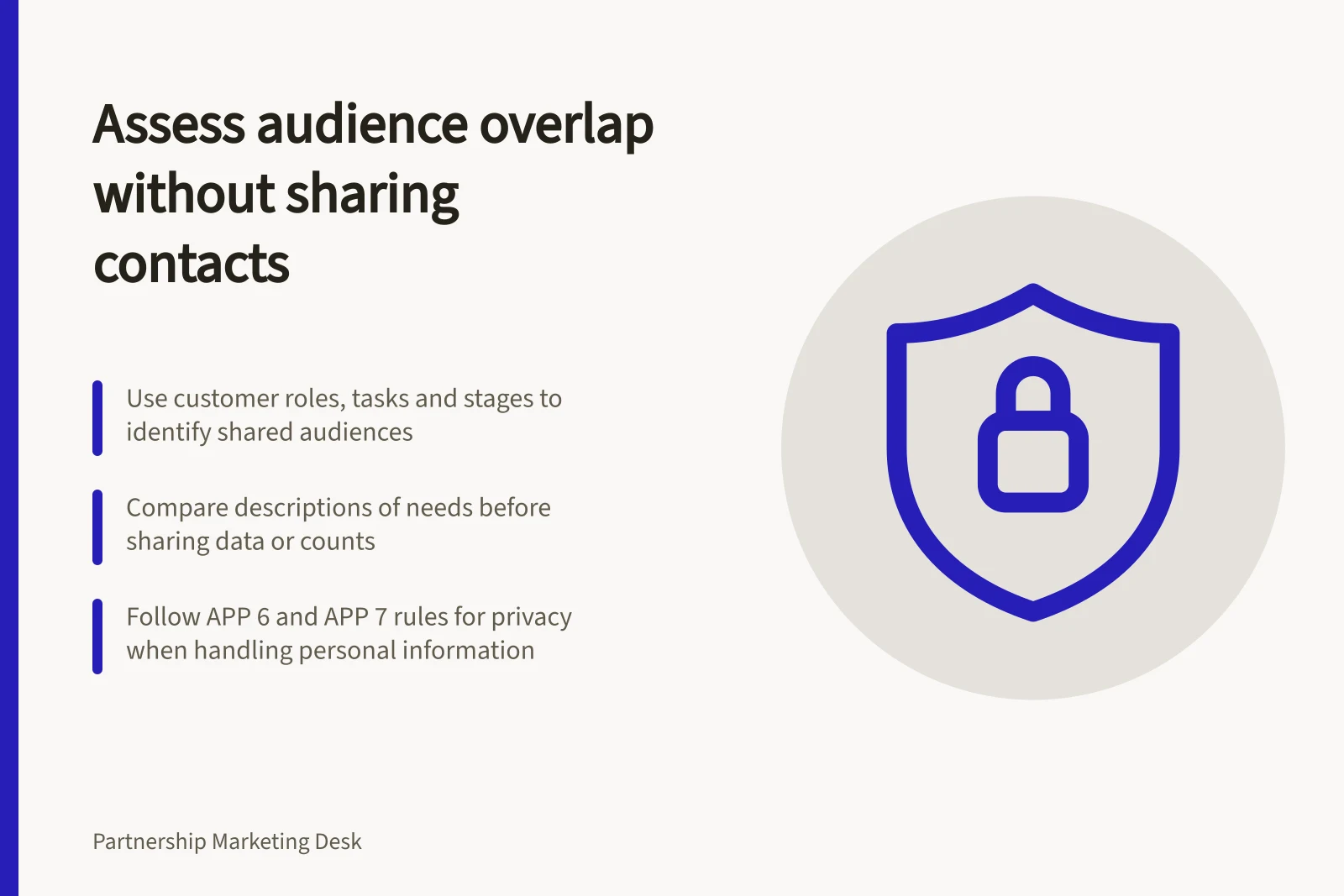
Assessing audience overlap without sharing private contact lists
Compare customer roles, tasks and buying stages using broad summaries while keeping contact data out of early partner assessment.
Assess audience overlap through customer roles, tasks and buying situations before considering individual contacts. Each prospective partner can describe whom it serves and the problems those people bring without exchanging names or email addresses. The decision is whether a joint activity could help a relevant audience, not whether two databases contain the same people.
Define the overlap the activity needs
Start with the proposed activity. A guide for finance managers may need both organisations to reach people making the same decision. A service hand-off may instead help customers at adjacent stages. Neither case automatically calls for matching individual records.
Ask each side to describe the relevant role, organisation type, trigger, question and stage using its own knowledge and records. Compare those descriptions before discussing counts. “We both reach small businesses” is too broad to support a topic; a shared question about preparing reliable monthly reports is a more useful hypothesis to investigate.
Steps to Assess Audience Overlap Without Sharing Contact Lists
- Define the proposed activityClarify whether it supports a shared decision-making stage or a hand-off between stages.
- Describe customer roles and tasks using internal knowledgeEach partner outlines their audience based on role, organisation type, trigger, question and stage.
- Compare broad descriptions before discussing countsAvoid assumptions based on industry labels; focus on shared questions like preparing monthly reports.
- Test a narrowly framed idea if descriptions alignIf both parties address the same customer question, explore joint content or resources.
- Decide next steps based on findingsRefine audience, consider hand-off model, or discontinue if overlap is too vague.
Compare broad descriptions
| Dimension | What each partner describes | Decision question |
|---|---|---|
| Customer task | What prompts the need | Same task or useful hand-off? |
| Role | Buyer, user or adviser | Would one message suit both? |
| Stage | Exploring, setting up or improving | Where would a joint resource help? |
| Reach | Channel each can appropriately use | Can each contribute distribution? |
| Exclusions | Customers the offer does not suit | Which promise needs narrowing? |
Check summaries before sharing them. A small or unusual group may still allow a person to be recognised, and a count describes only the group and period measured. It does not show that those people would engage with a proposed activity.
If both descriptions point to a specific customer question, test a narrowly framed idea. If they share only an industry label, refine the audience. If they serve adjacent stages, consider a hand-off explanation instead of presenting the audiences as identical.
Keep contact data out of the first decision
Do not exchange lists merely to see who matches. Names and work email addresses may be personal information. Where the Australian Privacy Principles apply, the rules for using or disclosing that information depend on the purpose and circumstances.
APP 6 governs many uses and disclosures; direct marketing has separate rules, including APP 7 where it applies. A matching tool does not settle whether the proposed handling is permitted.
Hashing an identifier can obscure it while still allowing datasets to be linked. Aggregation also needs a check for re-identification risk in the setting where the summary will be shared. If precise matching later proves necessary, define its purpose and output, minimise the information used or revealed, and have the relevant privacy owners assess the process before data moves.
A joint activity does not automatically allow either business to use or disclose personal information for direct marketing. APP 7 generally restricts an organisation from doing so unless an exception applies; where permitted, it must allow individuals to opt out and comply with their requests.
Record the shared customer question, the audiences’ relevant differences and what remains unknown. Decide whether a joint topic is plausible, needs a narrower segment or should stop. If the next decision genuinely requires person-level analysis, treat that as a separate data project.
Pros and Cons of Using Hashed Identifiers for Data Matching
- ProsHashing obscures individual identities while enabling dataset linkage for analysis.
- ConsRisk of re-identification remains if the hashing method is weak or combined with other data.
- Key considerationAlways assess re-identification risk in the context where the summary will be shared.