Joint Campaigns
Part of Strategic partnership marketing for B2B businesses
Defining shared value before planning a campaign
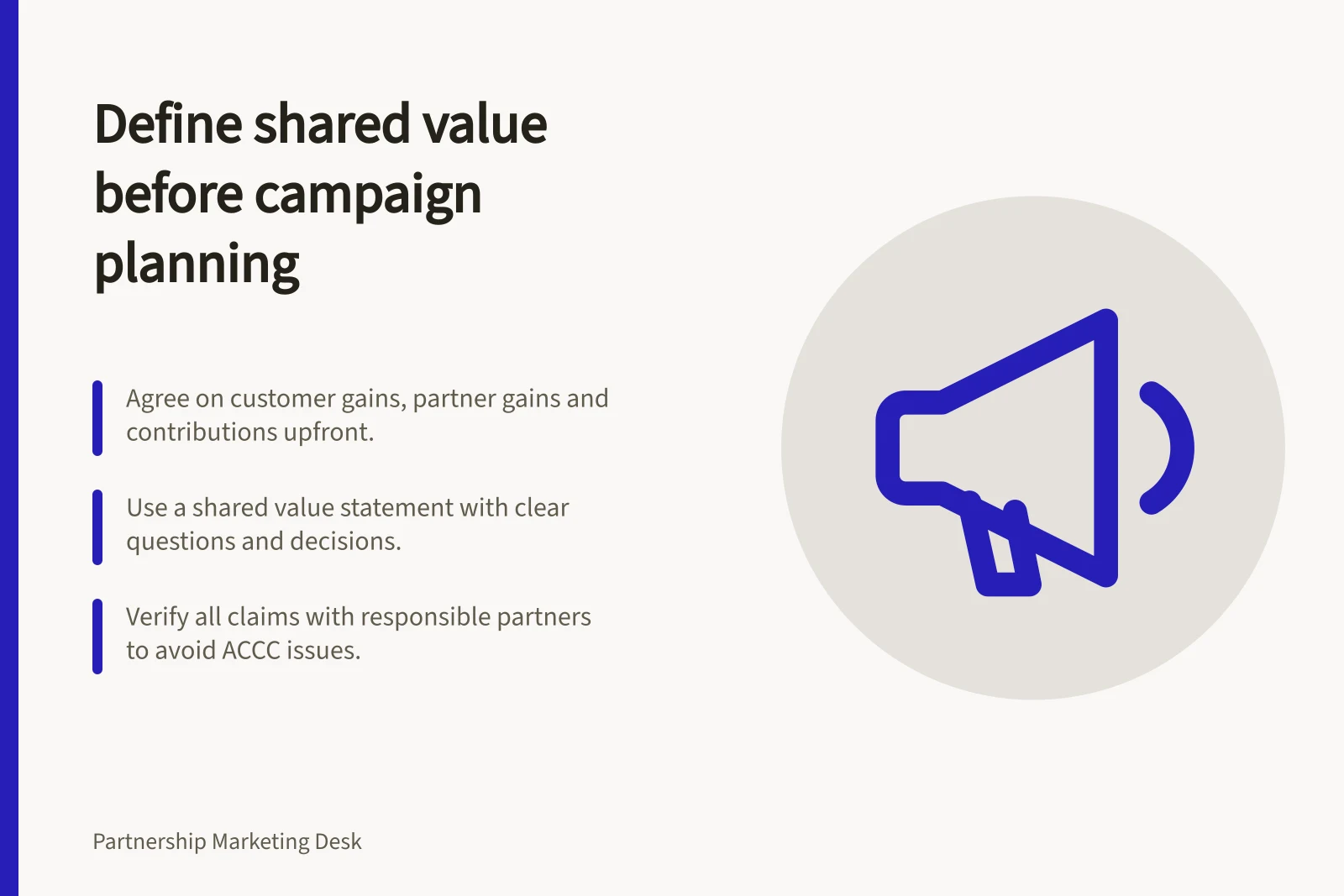
Agree the customer benefit, each partner’s return, distinct contributions and limits before choosing a joint campaign format.
Before planning a joint campaign, agree what the customer gains, what each partner gains and what each will contribute. If those answers cannot be stated plainly, choosing a format makes the disagreement harder to spot.
Start with value for the customer
Describe the problem from the customer’s point of view: what decision, task or uncertainty would the combined effort help with? State why both organisations are needed, and ensure each contribution makes the result more useful.
Try a sentence both teams can challenge: “For [customer group] trying to [task], our combined contribution helps them [specific next step] because [role of each partner].” Keep the proposed outcome within what the businesses can support. If value depends on eligibility, setup or another condition, include it in the proposition.
Leads may be a business objective, but they do not explain why a customer should give the joint activity time or attention.
Put each partner’s return on the table
Ask each team to name the outcome it wants: a relevant buying role, answers to recurring customer questions, or opportunities tied to an adjacent service. Aims need not be identical, but they must fit the same customer proposition.
Make expectations specific enough to review. “Greater visibility” could mean different things to each team. “Learn whether customers in this segment ask about the shared problem after seeing the material” gives a signal to examine. An enquiry is not a sale, and attendance alone does not show that the partnership helped customers.
Discuss uneven contributions openly. One partner may supply specialist knowledge while the other brings a suitable channel. Equal effort is not always necessary, but each side should understand the exchange. If one expects commissioned referrals and the other expects shared content ownership, resolve that before work begins.
Record the value statement
Keep a short shared record:
Question / Decision to record
- Who is the customer?
- A defined group and its current need.
- What improves for them?
- A decision, explanation or task the joint effort supports.
- Why both partners?
- The distinct contribution each can make.
- What does each partner seek?
- A specific learning or business outcome for each side.
- What limits the promise?
- Eligibility, capability or other material conditions.
- What would change the plan?
- A signal for proceeding, narrowing or stopping.
Ask someone from each organisation to explain the statement in their own words. If they describe different customers or outcomes, revise it before choosing a campaign format.
Check that the promise can be made accurately
Identify who can verify each customer-facing claim. A partner may know its own service well but be uncertain about the other’s requirements. Leave uncertain claims out until the relevant owner confirms them. The ACCC can require businesses to back up claims they make about their products or services, and it accepts reports about possible misleading or false claims.
If the joint value holds only for customers using a particular service, state that boundary now. A narrower, accurate proposition gives the campaign team a clearer brief. Then choose an activity capable of delivering the agreed customer value.
Key facts from Australian regulatory guidance
- ACCC responsibility
- Enforces truth in advertising claims under the Australian Consumer Law
- Claim verification requirement
- Businesses must be able to substantiate all customer-facing claims
- Reporting false claims
- Consumers and businesses can report misleading claims to the ACCC