Partner Evaluation
Part of Measuring a strategic marketing partnership
Deciding whether a partnership creates incremental demand
Assess whether a joint B2B marketing activity adds demand with a defined outcome, credible comparison and clear limits.
A partnership creates incremental demand when a credible comparison shows the joint activity produced more relevant customer actions than the usual approach would have. An opportunity attributed to a partner records involvement only — it does not show what would have happened without that activity.
Define the change and outcome
Frame the decision as two conditions. Does adding a partner's educational session and distribution to usual marketing produce more qualified enquiries from eligible accounts? Describe the usual approach so the comparison identifies the added package of activity.
Choose a primary outcome before launch. A qualified enquiry may be observable sooner than won business in a long B2B buying cycle, but it needs the same eligibility rule in both groups.
Record the eligible population, observation dates and how a later opportunity will be connected to its original account. Keep attendance and opportunity progression as separately labelled supporting outcomes.
Key Metrics for Assessing Incremental Demand
- Primary Outcome
- Qualified enquiry from eligible accounts
- Eligible Population
- Defined prior to launch, with clear eligibility rules
Choose a feasible comparison
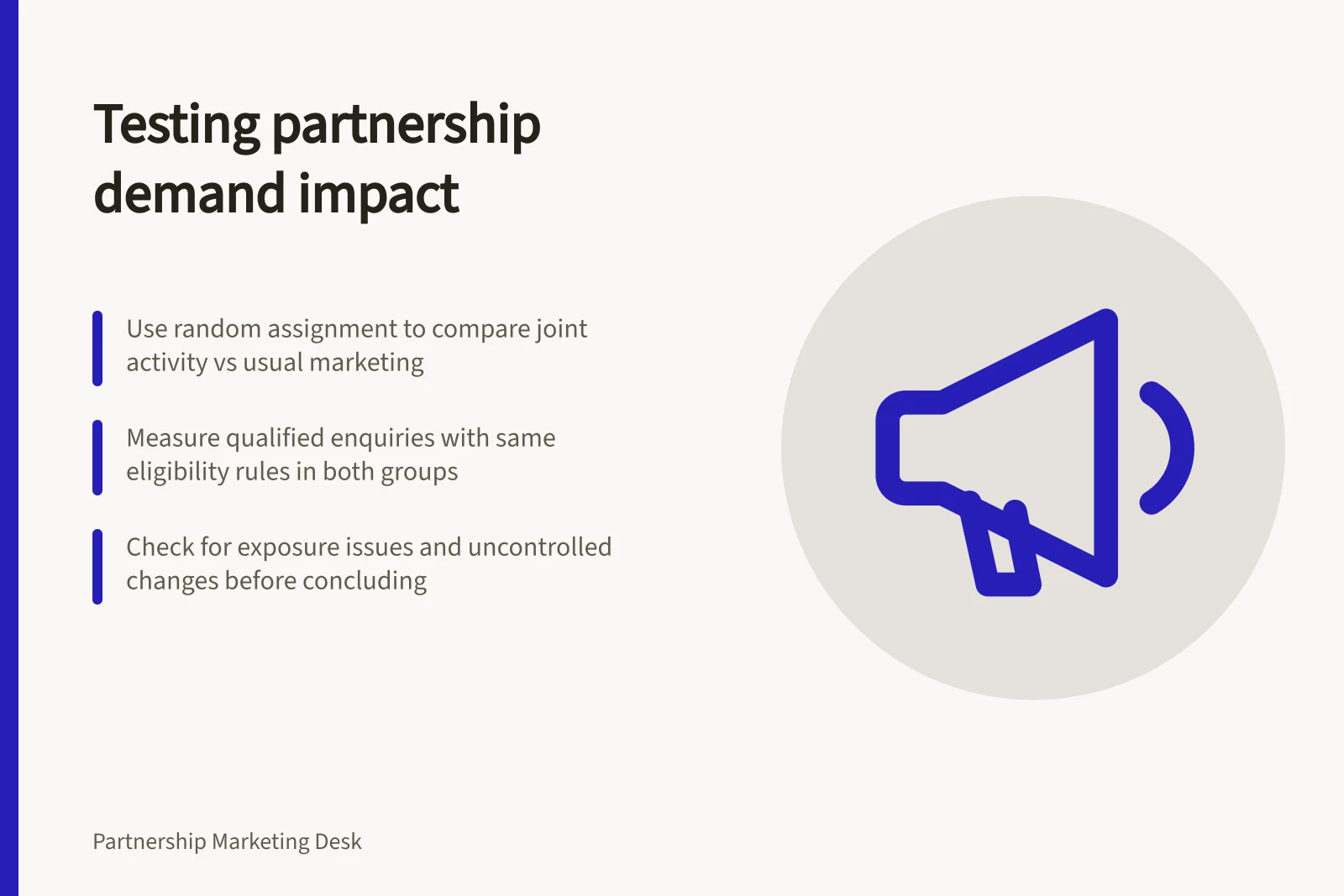
Where practical, assign eligible accounts or audiences to an added-activity group and a usual-approach group before launch, using random assignment when feasible. Measure the same outcome over the same period. Compare outcome rates against each group's eligible population, especially if group sizes differ. Check for material differences in other marketing exposure.
This design tests the added package of joint activity. It does not identify which partner contribution caused a difference unless the design separately varies those contributions.
If assignment is impractical, a phased launch or suitably similar segments may provide directional insight. Record why groups are comparable, how starting demand differs and what else changed. An unmatched before-and-after rise cannot establish causation: seasonality, an existing sales push or another campaign may have contributed.
Evaluating Incremental Demand from a Partnership
- Added-Activity GroupEligible accounts assigned before launch, receiving partner’s educational session and joint distribution
- Usual-Approach GroupEligible accounts receiving only standard marketing activities
- Key RequirementSame outcome measure (e.g. qualified enquiry), same observation period, random assignment where feasible
Pros and Cons of Using a Phased Launch for Comparison
- ProsPractical when random assignment is not feasible; useful for directional insight in real-world settings
- ConsCannot establish causation without controlling for external factors like seasonality or concurrent campaigns
Check whether the result can be trusted
Use the same deduplicated outcome definition in both groups. Check whether comparison accounts received partner activity through another route and whether accounts assigned to the added activity could actually receive it. Keep exclusions, exposure failures and deviations visible. Do not change the outcome window after seeing an early result.
B2B outcomes can arrive after a campaign ends. Choose an observation period suited to the decision cycle, then distinguish mature results from open opportunities. Small groups can produce unstable differences.
Where the analysis can estimate uncertainty, show it; otherwise state the group sizes and limitations plainly. An inconclusive result is not proof of zero effect.
Decide what to do next
If the comparison suggests extra qualified demand, examine its quality and the cash spend and staff work required from both partners. Attributed pipeline is not an incremental return: some opportunities may never close, and some may have arisen without the joint activity.
Finding / Next decision
- Credible gain in relevant demand, with acceptable effort
- Repeat or expand within the tested audience and conditions
- Result too uncertain or comparison compromised
- Improve the comparison or run a narrower test
- No useful gain under a sound comparison
- Reconsider the offer, audience or activity
Record what was actually tested. A gain for one audience and topic does not establish that every campaign with the same partner will add demand.
Steps to Determine Incremental Demand in a B2B Partnership
- Define the change and outcomeSpecify the joint activity and primary outcome (e.g. qualified enquiry from eligible accounts)
- Choose a feasible comparisonUse random assignment or comparable segments; ensure both groups have similar exposure history
- Check result trustworthinessVerify consistent outcome definition, exposure accuracy, and stable observation window
- Decide next actionRepeat, expand, refine, or reconsider based on credible gain and effort assessment