Joint Campaigns
Part of Measuring a strategic marketing partnership
Measuring shared campaign outcomes without double counting
Reconcile two partners’ campaign reports into distinct people, organisations and opportunities while retaining useful interaction detail.
Count each shared campaign outcome once, at the level the metric describes, and keep the partner interactions tied to it. A person, an organisation and an opportunity are different units. Choose the unit for each measure before you combine two partners’ reports.
Define outcomes before joining reports
A joint campaign may produce page visits, registrations, attendees, enquiries and opportunities. Name each event and the period in which it counts. Decide whether a repeat registration is another action or the same person returning, and whether an enquiry must meet an eligibility test.
Keep each partner’s channel activity, such as email sends, separate from the shared outcome count.
A short reporting dictionary can state the metric, unit, date, inclusion rule and record owner. “Distinct attendees” needs an attendance event and a person-level matching rule. “Opportunities created” needs a qualifying opportunity record and creation date. A dashboard label does not settle those choices.
Reporting dictionary: what every shared metric needs
- Metric nameThe outcome being counted, e.g. registrations, attendees, enquiries, opportunities created
- UnitWhether a person, an organisation or an opportunity is counted once
- Date periodThe window in which the event counts, and which date applies (registration date, attendance date, opportunity creation date)
- Inclusion ruleHow repeats are treated, and whether an enquiry must pass an eligibility test
- Record ownerWho holds the authoritative record for that metric
Keep interactions and distinct outcomes separate
Retain observable interactions with their campaign, partner, event type, date and an identifier the organisation is permitted to use. Build separate person, organisation and opportunity views as needed, each with one record per distinct unit. Connect interactions to outcomes only where the match can be supported.
A shared email address may identify one registrant across two permitted records; a changed address may need review. Two people at one organisation remain two people, though they may relate to one buying opportunity. Do not merge people merely because they share a company name, or merge opportunities merely because the account is the same.
Agree what information each partner may use or disclose for reconciliation. If reliable, permitted matching is unavailable, show each partner’s count and the verified overlap. Leave the combined distinct total unknown rather than guessing.
One record per distinct unit, interactions kept separately
- PersonOne record per distinct person. A shared email address may identify one registrant across two permitted records, but two people at one organisation remain two people
- OrganisationOne record per distinct organisation. Do not merge people merely because they share a company name
- OpportunityOne record per distinct opportunity ID. Do not merge opportunities merely because the account is the same
- InteractionRetained separately with its campaign, partner, event type, date and a permitted identifier, and connected to an outcome only where the match can be supported
Reconcile each stage
- Remove repeated records within each partner’s extract under the agreed rule.
- Match records between partners and retain the match decision or unresolved status.
- Count distinct outcomes at each stage using that stage’s unit.
- Retain both partner interactions on a matched outcome.
- Compare final counts with source extracts and explain differences.
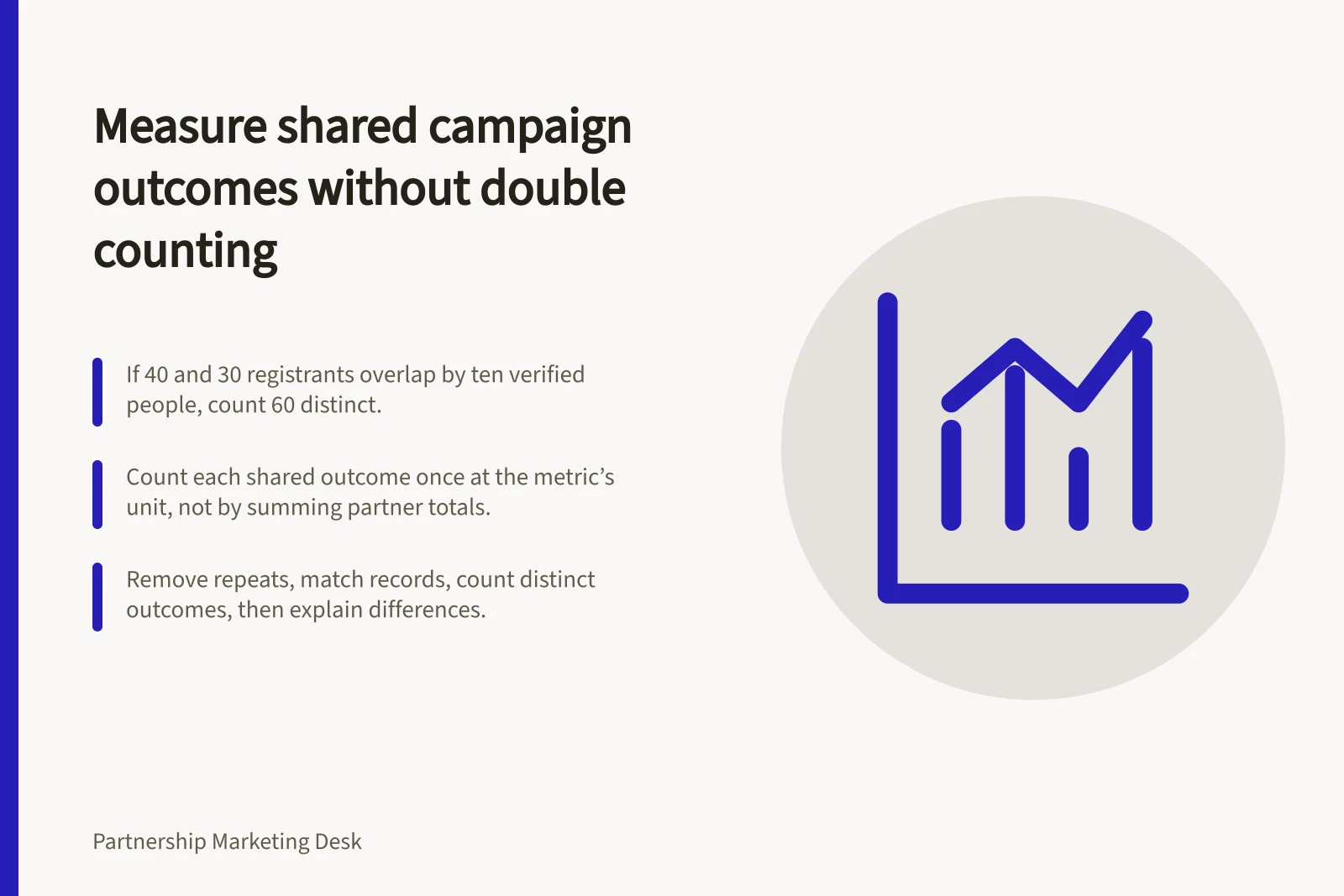
For example, if one partner reports 40 registrants, the other 30 and ten are verified as the same people, the combined distinct count is 60. That says nothing about how many attended or became opportunities. If the overlap is only suspected, 60 is not a verified total.
Reconciling each stage of a joint report
- Remove repeats within each extractApply the agreed rule to each partner's own records first
- Match between partnersRetain the match decision or an unresolved status for every record
- Count distinct outcomes per stageUse that stage's unit when counting
- Keep both interactionsRetain each partner's interaction on a matched outcome
- Reconcile to sourceCompare final counts with the source extracts and explain the differences
Keep pipeline and credit totals clear
Count a distinct opportunity ID once in the combined pipeline and show its stage or outcome. Record each partner’s involvement as an attribute or in a separate credit view. If both partners touched one opportunity, assigning its full value to each partner and summing their columns counts it twice.
Where a credit model is used, keep the distinct outcome count separate from the attributed credit, state its unit, model and denominator, and leave model-specific detail to its own article.
At review, record the data period, definitions, source systems, verified duplicates and unresolved matches.