Co-Marketing Agreements
Co-authored research and content
Co-authored research works when partners agree on a question, a method and responsibility for the findings before either brand starts writing.
Use this decision framework before either brand writes: settle the question, method, responsibilities, authorship and disclosure. Co-authored research can extend reach and expertise, but two logos do not make a weak claim stronger. Treat a report as a research product, with a clear owner for every dataset, calculation and public statement.
Decision framework before writing
- Settle the question
- Choose the method
- Allocate responsibilities
- Agree authorship
- Plan disclosure
Start with a question both sides can answer
Write the decision the audience will make from the work, then ask whether the available data can answer it. If one partner has customer interviews and the other has transaction records, decide whether those sources can be combined responsibly or should appear as separate perspectives. Do not call a convenience sample representative of an entire market.
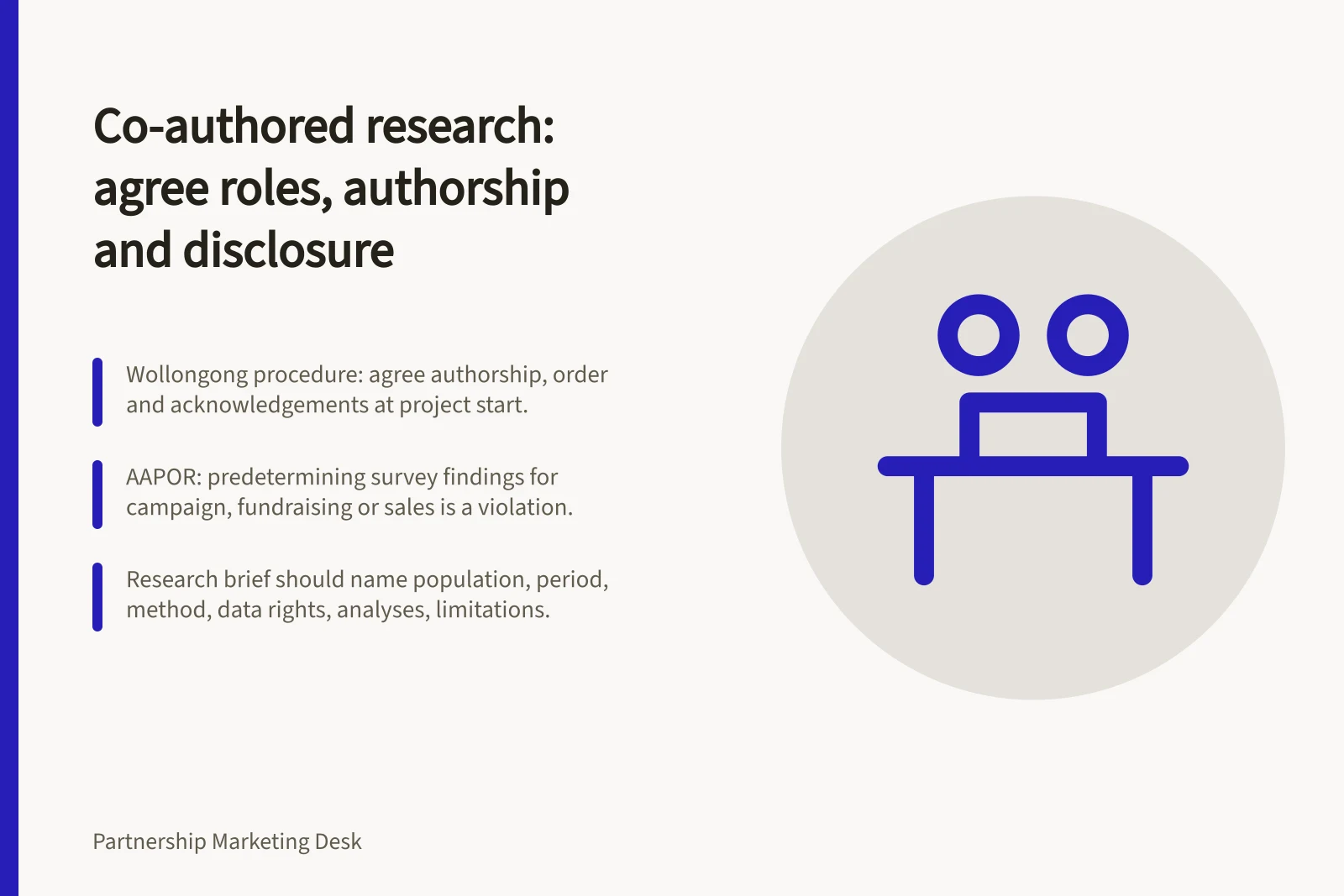
A research brief should name the population, period, method, data rights, planned analyses and limitations. For surveys, first check whether a survey is the best method for the question and whether existing data or another method would be more suitable. If the work is not a survey, apply the same discipline of transparent methods without pretending survey rules cover every method.
For co-authored content that is not research, such as a commentary, guide or case study, decide whether a shared piece adds value through the partners' complementary expertise. Agree on its audience and purpose, who has editorial control, how claims will be approved, and where it will be published. If a joint voice is not useful or the partners cannot agree on those decisions, separate contributions may be a better fit.
Allocate responsibility before collection
Task / Owner to name
- Source data and permission
- The partner that collected or controls it
- Cleaning and definitions
- A named analyst with a review trail
- Statistical or qualitative interpretation
- The person qualified to explain the method
- Public claims and charts
- A reviewer from each partner
- Corrections after release
- One editorial lead and a contact route
Keep the raw source and calculations traceable. Mark whether a claim is a finding, an interpretation or a recommendation. Agree that no sponsor can silently change a result to fit a campaign message.
Before collection, name who is responsible for each dataset, the analysis and public statements. Agree how those responsibilities connect to data rights, corrections and publication decisions.
Choose an approach that fits the work
For evidence-led work, decide whether existing information, a survey or another research method can answer the question. AAPOR advises considering whether a survey is suitable and whether other methods or data are needed. Detailed survey planning belongs in a supporting guide.
For work involving people, their data or biospecimens, consider the National Statement on Ethical Conduct in Human Research (2025). It addresses ethics committee review and monitoring, so check whether review applies to the project.
Agree that survey findings will not be predetermined to serve either partner's campaign, fundraising or sales objectives. AAPOR treats that use as a violation of its Code of Professional Ethics.
Judge quality by how problems are handled
A survey's size, scope or prominence is not, by itself, a measure of its quality. AAPOR cites the principle that quality depends on the attention given to preventing, measuring and dealing with problems that can arise. For a joint project, identify weaknesses, explain how they affect the findings and retain material limitations in the published account rather than presenting the work as more conclusive.
Agree authorship and recognition early
Authorship is distinct from funding, data provision and promotion. The University of Wollongong's Authorship Acknowledgement Procedure says collaborating researchers must discuss and agree on authorship, authorship order and acknowledgements at the initial stage of a project.
The Australian Code for the Responsible Conduct of Research 2018 was developed by the National Health and Medical Research Council, the Australian Research Council and Universities Australia. Its supporting guides include Authorship and Collaborative Research; use that guidance alongside applicable institutional policies.
Institutional policies should set out criteria for author eligibility and authors' responsibilities. Use the Code's authorship guidance and applicable policies to inform the partners' agreement rather than assuming that a contribution automatically settles authorship.
Record how decisions about authorship and acknowledgement will be revisited if contributions change.
Publish contribution and method clearly
Tell readers who funded the work, who collected data, who analysed it and what each partner contributed. Disclose limitations near the relevant result, not only in a final page of small print. If the research supports a narrow group or time period, keep the conclusion narrow.
Choose one primary report location and a distribution plan for partner sites. Partners can publish distinct summaries, commentary or audience-specific applications rather than identical full copies.
Google may select one canonical from substantially duplicate pages, and a canonical declaration is a signal rather than a guarantee. Agree ownership, correction procedures and republication rights before launch so distribution does not create a version-control dispute.
In this guide
- Defining a research question both partners can supportA joint research question should matter to the audience and be answerable with data the partners can lawfully and accurately use.
- Assigning responsibility for data verificationIn a joint report, “both partners checked it” is not a verification plan.
- Keeping partner contributions visible in a joint reportReaders should be able to tell who asked the question, who supplied data, who analysed it and who paid for the work.
- Distributing co-authored content without identical site copiesTwo partners can distribute one research project without posting the same full article on both sites.